In short. Versailles is three visits in one: the palace with the Hall of Mirrors, the gardens of Le Nôtre, and the Trianon estate at the far end of the park. With a ticket for the palace, gardens and Trianon you can see all of it in one day.
Secure your spot
Palace of Versailles: Entry Ticket + Gardens + Estate of Trianon
4.4· 13,355 reviews
from €22
Book tickets and tours →The palace: start in the courtyard
You arrive in the Royal Court, a huge forecourt of brick, stone and gold, and you understand quickly that this was never meant to be a home. It was a stage for the king. The front of the palace stretches for 402 metres, and inside you walk through the rooms in the same order the courtiers did.
The Grand Apartments of the King and the Queen open on the first floor. Look at the King’s bedchamber: Louis XIV turned it into his bedroom in 1701, and he died here on 1 September 1715. In the Salon of Apollo, the old throne room, the eight-foot silver throne was melted down in 1689 to pay for a war. A wooden one replaced it.
Then comes the Hall of Mirrors, and it is still a shock. 578 mirrors face 17 tall windows that look onto the gardens, so the light of the afternoon bounces from one side to the other. The painted vault above is the work of Charles Le Brun, in 30 scenes about the first years of the king’s personal rule. In the evening, candles did the rest. Much later, on 28 June 1919, the Treaty of Versailles was signed in this room.
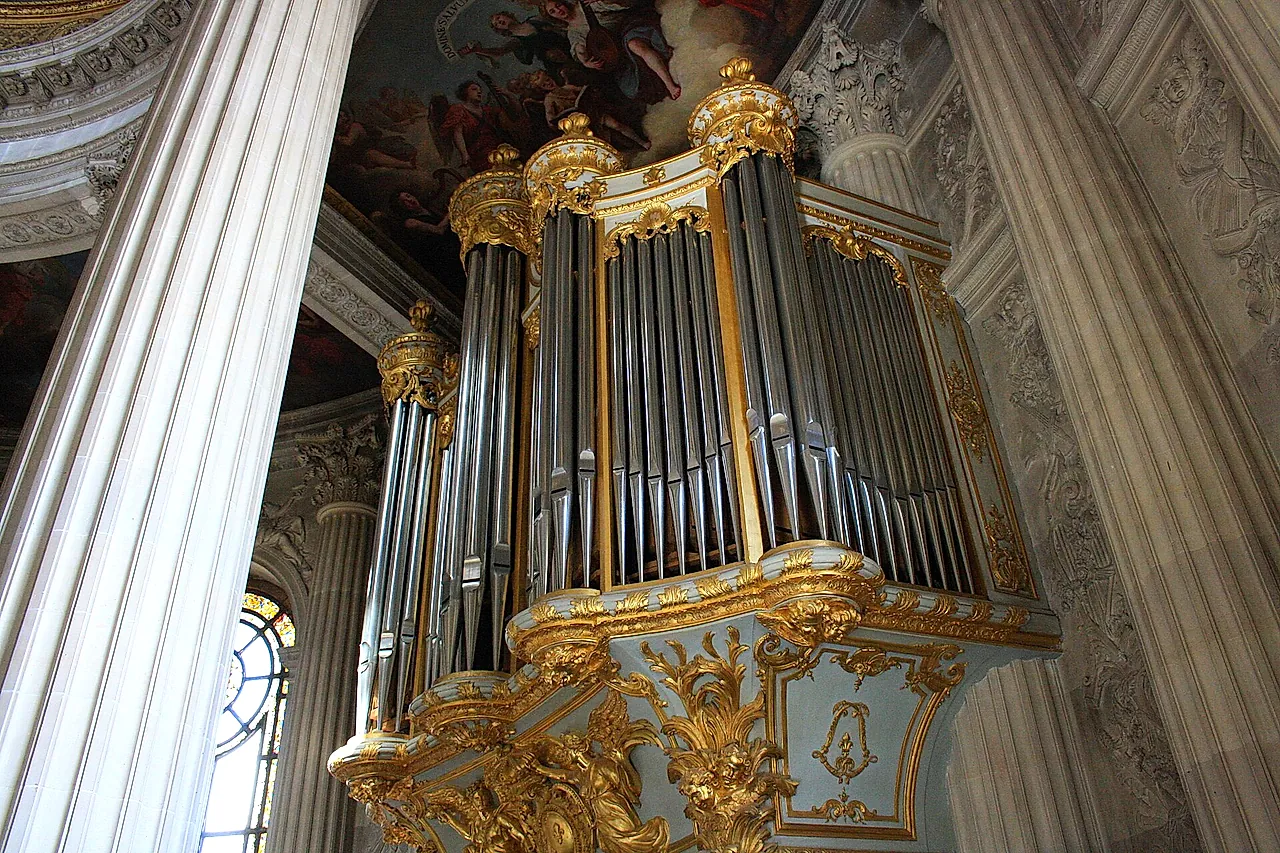
Do not rush past two more rooms. The Royal Chapel is 40 metres high and was finished in 1710. The Royal Opera, inaugurated on 16 May 1770 for a royal wedding, is built almost entirely of wood painted to look like marble, and that is why the sound inside is so good. On some days you can also walk through the Hall of Battles, Louis Philippe’s gallery of French victories.
Tip: arrive at opening time or in the late afternoon, and look up at the ceiling of each room: that is where the stories are painted.
The gardens: look back at the palace
From the terrace behind the Hall of Mirrors the gardens open out in one long line. André Le Nôtre laid them out, and the formal part covers about 93 hectares of lawns, flower beds and clipped hedges, inside a park of roughly 815 hectares.
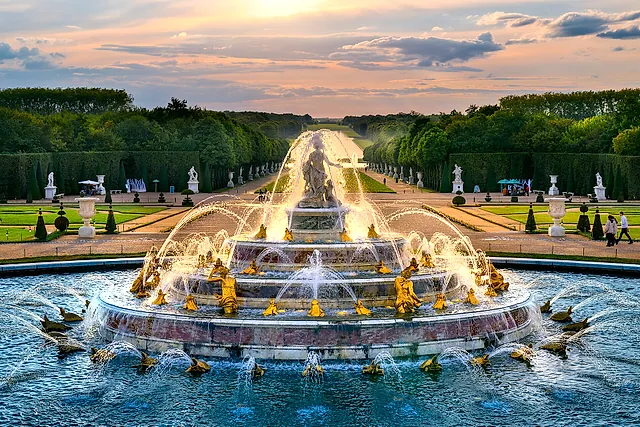
Walk down to the Latona Fountain, rebuilt in 1686-87. It tells a story from Ovid: Latona and her children were insulted by peasants, and Jupiter turned the peasants into frogs. Look for the frogs. Beyond it a long green carpet of lawn, the Tapis Vert, leads to the Apollo Basin, and then the Grand Canal begins. It is 1,500 metres long and 62 metres wide, and it was dug between 1668 and 1671. In the days of Louis XIV there were gondolas on it, a gift from the Doge of Venice.
Turn around at the Apollo Basin and look back. The whole palace opens up behind you.
Tip: the gardens are big, so choose your route before you set off. If you like music, pick a day when the fountains play: on show days from spring to early autumn they play to music.
The groves: the secret rooms of the park
Away from the main avenues the gardens turn into a series of hidden groves, or bosquets, hedged rooms with a fountain or a statue in the middle. One of them is the Bosquet des Bains d’Apollon, a rocky grotto covered in greenery, with marble statues. It was remodelled by the painter Hubert Robert under Louis XVI.
Near the palace is the Orangery, rebuilt in the 1680s by Hardouin-Mansart. It sheltered orange trees from the winter frost. Further south, the Pièce d’eau des Suisses is a lake of more than 15 hectares, dug by the Swiss Guards.
The Trianon: another Versailles
The Trianon estate lies at the far end of the gardens, and it feels like another world. Louis XIV built the Grand Trianon in 1687 as a private retreat, away from the court. It is a low building of pale stone, with an open colonnade of red marble columns facing the garden. Napoleon and several later rulers stayed here too.
The Petit Trianon is smaller and more intimate. It is a neoclassical house by Ange-Jacques Gabriel, built in the 1760s, and in 1774 Louis XVI gave it to Marie Antoinette. Her boudoir has mirrored panels that rise and fall with a crank, to cover the windows and reflect the candlelight.
Last comes the Queen’s Hamlet. Ordered in 1783 and designed with the painter Hubert Robert, it is a little village around a pond, with a mill, a dairy and a dovecote. It looks like a stage set, but it was a real farm: it grew fruit and vegetables for the royal table. Nearby, the Queen’s Theatre from 1780 has about 100 seats and is still in its original state.
Tip: the Trianon is about 25 to 30 minutes on foot from the palace, so keep it for the afternoon, when you want to walk more slowly anyway.
How to choose
- Short on time? See the Hall of Mirrors and the Apartments, then walk down to the Apollo Basin and look back.
- A full day? Rooms in the morning, gardens at lunchtime, Trianon in the afternoon. This is the route that a ticket for the palace, gardens and Trianon is made for.
- Want to understand the rooms? Choose a guided tour, which takes you through the apartments in the right order and tells you who lived in each one.
Read the history of Versailles before you go, or the visit tips to plan the day. For opening days, see opening hours, and for the journey, getting there. All the options are on the Versailles page.